Bullet time for robot foundation models

Vision-language-action models decide at the speed of a conscious thought. Bodies get hit at the speed of a spinal reflex. SPINE (codename Sandevistan) is a small, embodiment-agnostic reflex layer that lives between the VLA's plan and the actuators: it reacts in milliseconds, slows the plan's clock when it must, and overrides it when it has to.

Named after the Sandevistan of Cyberpunk 2077, a spinal implant that lets its owner move while the world stands still, and after the bullet-time shots of The Matrix. In the body the trick is older than either: it is the spinal cord.

sensor skin · spindle · IMU muscle actuator spinal cord cortex spinal loop · tens of ms no cortex needed cortical loop 100s of ms a VLA closes its loop through the cortex path; SPINE adds the spinal one
1999 · bullet time
The Matrix. Time nearly stops and Neo still has room to move. SPINE wants the same for a robot: slow the plan's clock, keep the reflexes fast.Clip: The Matrix (1999), Warner Bros., via GIPHY.
2022 · sandevistan
Cyberpunk: Edgerunners. The Sandevistan, a spinal implant that speeds its owner up until the rest of the world seems frozen. This project borrows its name.Clip: Cyberpunk: Edgerunners (2022), Studio Trigger and CD PROJEKT RED for Netflix, official GIF via GIPHY.
Part 1

How animals act before they think

The nervous system runs on several clocks

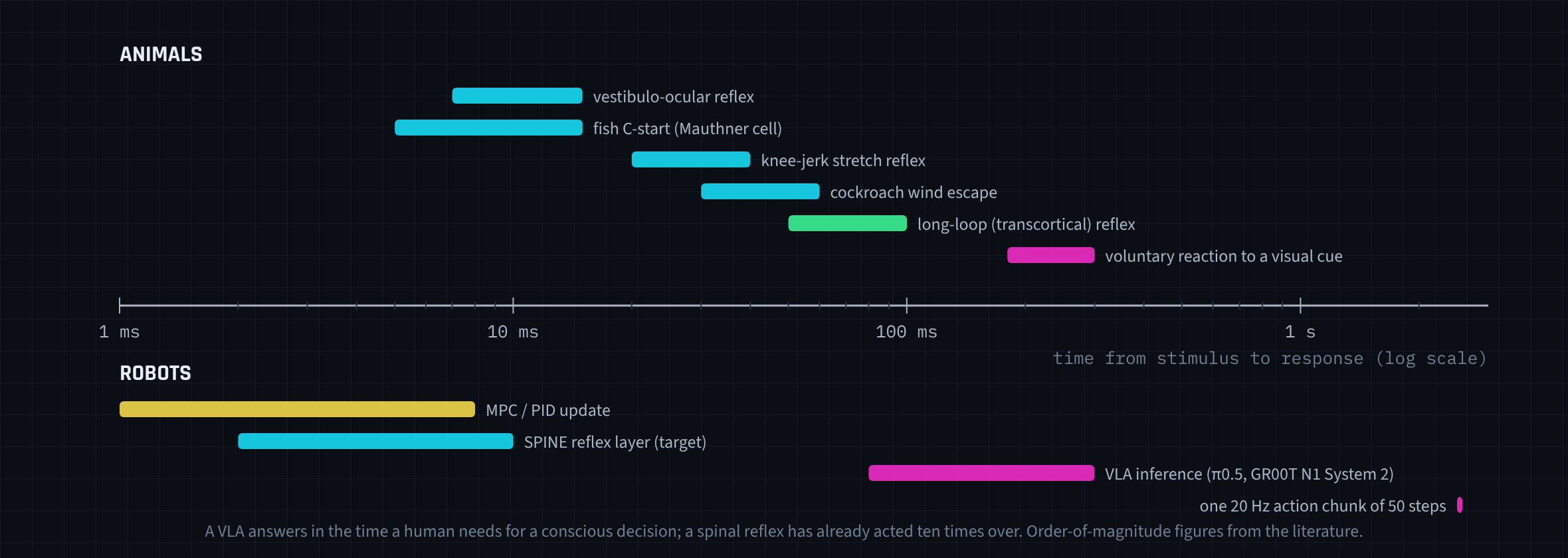
A conscious reaction to something you see takes about 200 ms. A spinal reflex has acted in 20–40 ms, the eye-stabilising reflex in about 10 ms, and a fish has already turned away from a predator in the same time. These are not the brain being fast; they are loops that do not go through the brain at all. The cortex sets goals and tunes the reflexes, the spinal cord and brainstem execute, and when the two disagree in an emergency the reflex wins first and the cortex finds out afterwards.

Reaction latencies of animal reflexes and robot control loops on one logarithmic time axis
Figure 1. Biology and robots on one time axis. A VLA's inference and its action chunk sit where conscious decisions sit; nothing on the robot side plays the role of the spinal cord. Order-of-magnitude figures from the literature.

Five reflexes worth copying

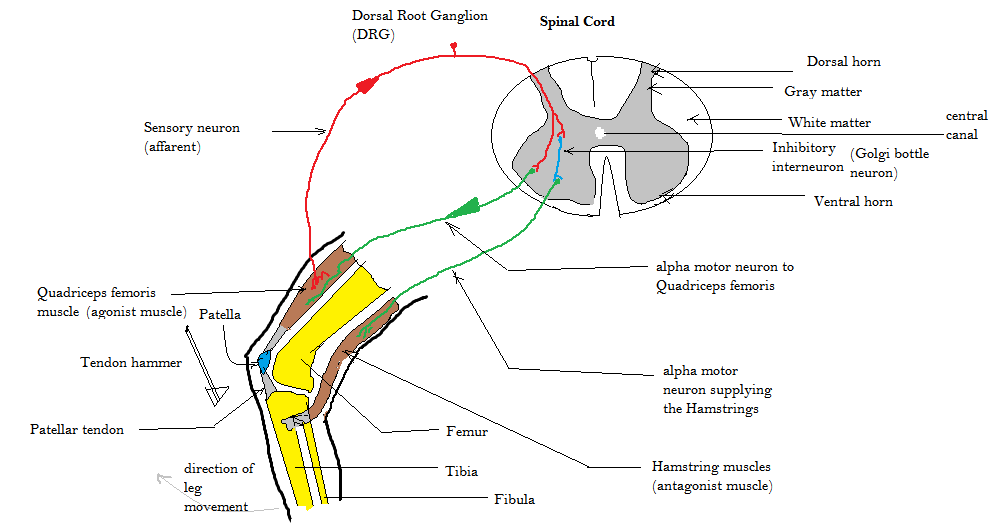
Diagram of the patellar tendon reflex arc

Stretch reflex (knee-jerk)

A tap stretches the quadriceps; muscle spindles fire, one synapse in the spinal cord, and the muscle contracts about 30 ms later. The same loop keeps posture up against every small push, all day, without a thought. Lesson: a one-hop loop with the right sensor beats a smart loop that is late.

Image: Amiya Sarkar, Wikimedia Commons, CC BY-SA 4.0.
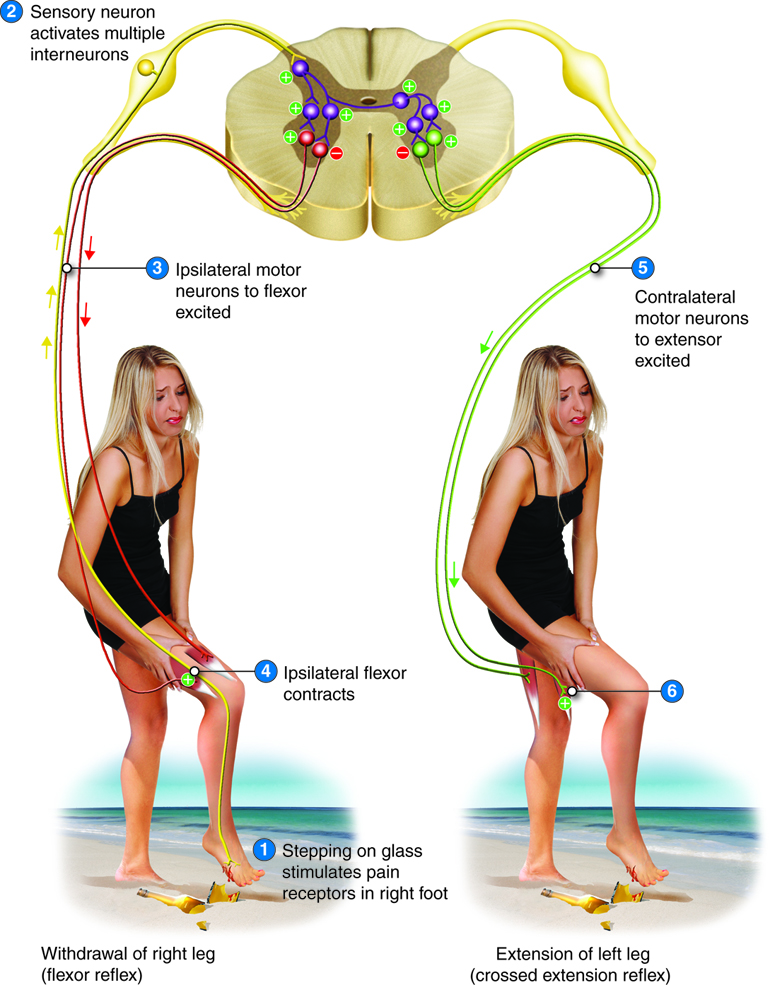
Diagram of the withdrawal and crossed extensor reflexes

Withdrawal and crossed-extensor reflex

Step on a nail: the leg lifts before the pain is felt, and the other leg stiffens so you do not fall. One stimulus, a coordinated whole-body response, all wired below the brain. Lesson: reflexes are not single-joint; they know the body.

Image: Cenveo / OpenStax Anatomy & Physiology, Wikimedia Commons, CC BY 4.0.

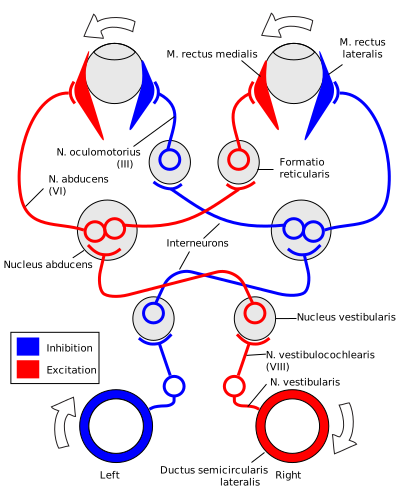
Diagram of the vestibulo-ocular reflex

Vestibulo-ocular reflex

Turn your head and the eyes counter-rotate within about 10 ms, driven by the inner ear's accelerometers and gyroscopes. The image stays still while you move. Lesson: the IMU is the fastest sense there is, and it belongs in the reflex, not in the planner.

Image: .Koen, Wikimedia Commons, CC BY-SA 4.0.

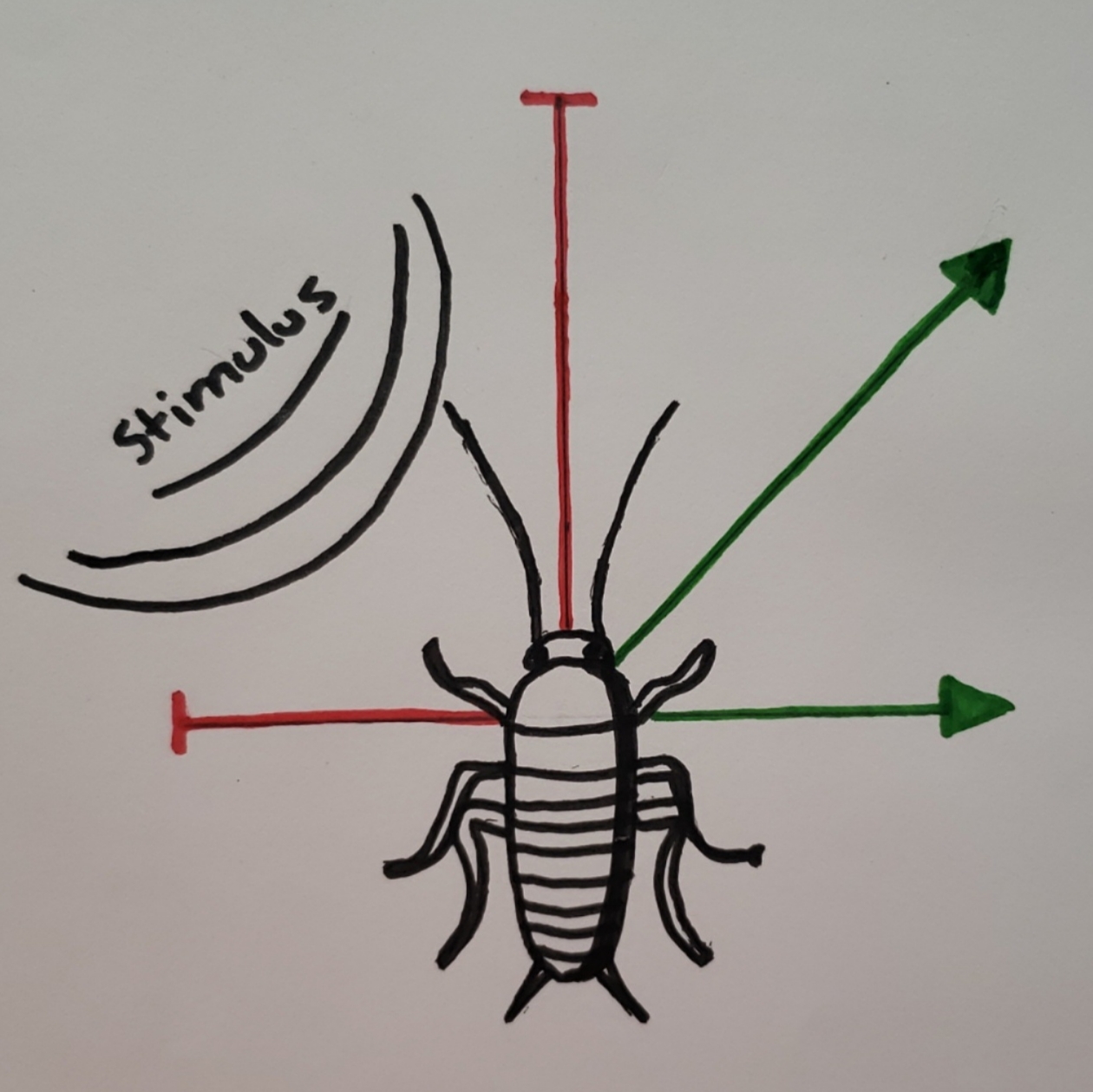
Diagram of the cockroach escape reflex

Escape reflexes

A puff of wind on a cockroach's cerci reaches giant interneurons and it is turning away in tens of milliseconds. A fish's Mauthner cell triggers a C-start in about 10 ms. These circuits take over whatever the animal was doing. Lesson: an override path with the authority to interrupt the plan.

Image: Nickfox14, Wikimedia Commons, CC BY-SA 4.0.

touch during SWING lifts higher, steps over touch during STANCE pushes down harder

The stumbling corrective reaction

Brush the top of a walking cat's paw while the leg swings forward and the leg lifts higher to clear the obstacle. Brush it while the paw is planted and the leg pushes down harder. Same stimulus, opposite response, chosen by the phase of the ongoing movement (Forssberg, 1979). Lesson: a good reflex reads the plan's phase before it acts. This is the biological version of the "bullet time" rule below.

Try it: your reflexes against the machines

Press Start, wait for the pad to light up, then click (or tap) it as fast as you can. Your time is compared with a spinal reflex and with a VLA that has to finish one inference and start a new chunk.

idle
wait for yellow
you
–
spinal reflex / SPINE
30 ms
VLA re-plan
300 ms

What the spinal cord teaches a robot designer

  • Separate clocks. Fast loops with fast senses, slow loops with rich senses; neither waits for the other.
  • Phase-aware. The right correction depends on where the movement is; reflexes read it from proprioception.
  • Authority. In an emergency the reflex acts first; the plan is informed, then revised.
  • Generic circuits. The same motifs serve legs, arms, eyes and fins; the body-specific part is the wiring to the muscles.
  • Tuned, not replaced. The cortex gates reflex gains for the task at hand instead of recomputing the reflex.
Part 2

The idea: SPINE

A reflex layer between the plan and the actuators

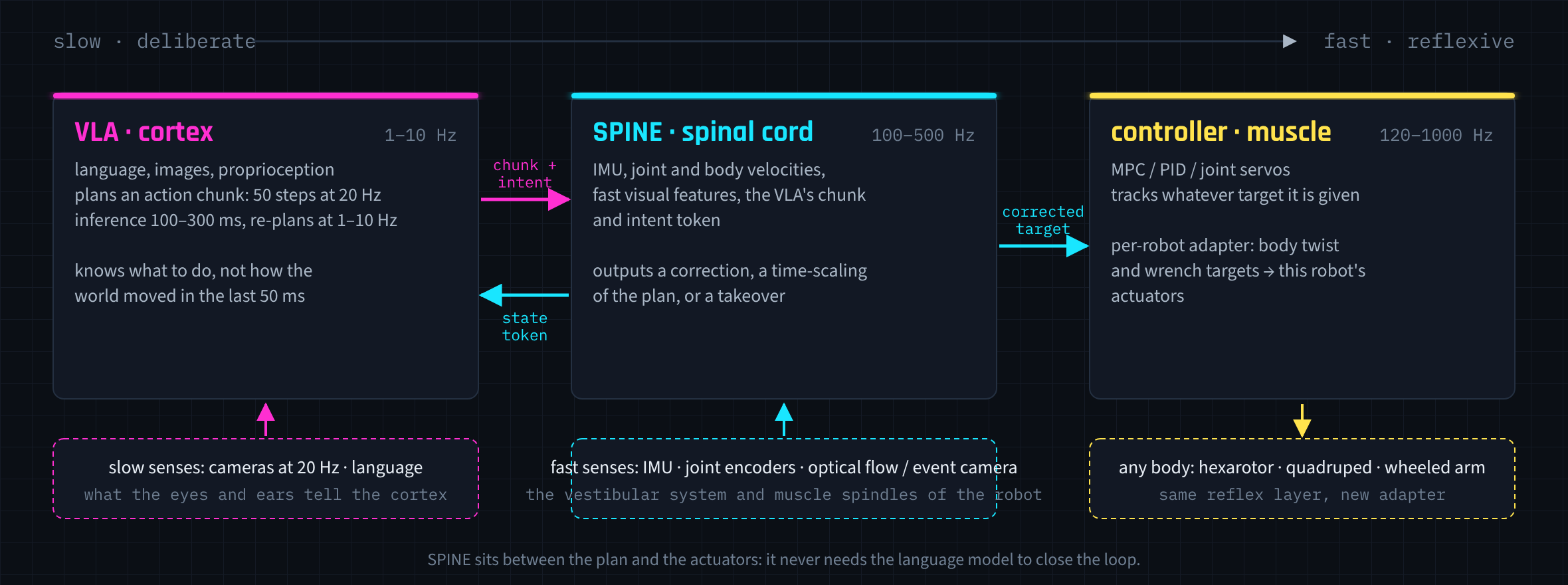
A VLA such as π0.5 or GR00T N1 reads language and images, thinks for 100–300 ms, and emits a chunk of actions that the robot then plays back for a second or more. Everything that happens to the body inside that window, a gust, a slip, a bump, a payload shift, is handled by whatever low-level controller sits underneath, which knows nothing about the task. SPINE is the missing middle: a small network that runs at hundreds of hertz on proprioception and fast visual cues, sees the VLA's chunk and its intent, and decides in each millisecond whether to let the plan run, correct it, slow it down, or take over.

Three control loops: the VLA as cortex, SPINE as spinal cord, the controller as muscle
Figure 2. Three loops, three clocks. SPINE takes the VLA's chunk and intent as input, the robot's fast senses as its own, and hands a corrected target to the controller. It talks back to the VLA with a state token, so the planner learns to expect it.
  • Inputs. IMU, joint and body velocities, contact and force estimates, cheap high-rate visual features (optical flow, an event camera), plus the VLA's current chunk and intent token.
  • Outputs. A correction to the chunk in body coordinates, a scaling of the chunk's phase velocity, or a takeover; and a state token back to the VLA.
  • Model. Small, a few million parameters, trained with supervision from corrections made under injected disturbances; small enough to run on an embedded CPU or a microcontroller-class accelerator at 200–500 Hz.
  • Interface to the VLA. The intent token is injected into the VLA (an intermediate layer or the action expert) and the VLA is fine-tuned with SPINE in the loop, so the planner's chunks come out already expecting a reflex underneath. Replacing the VLA means re-training that injection, not the reflex.

Bullet time: own the plan's clock

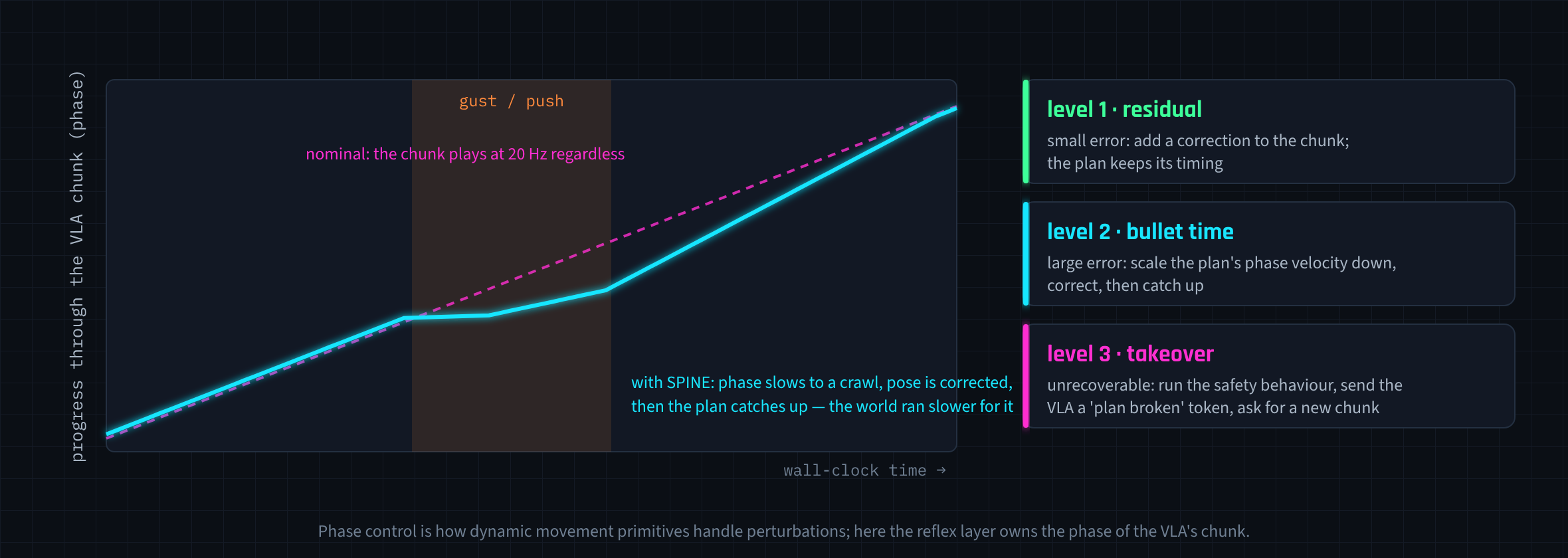
The obvious way to override a plan is to replace its actions. That throws the plan away and leaves the VLA confused about where its chunk went. The cat's stumbling reaction suggests a better rule: act relative to the phase of the plan. SPINE owns the phase variable that plays the VLA's chunk. Under a small disturbance it adds a residual and keeps the clock running. Under a large one it slows the clock to a crawl, corrects the body while the plan "waits", then lets the clock catch up. The chunk is never discarded, so when the disturbance is over, the robot is exactly where the plan expects it to be, just a little later. Dynamic movement primitives have used phase stopping for perturbations for two decades; here the phase belongs to a learned reflex and the plan comes from a foundation model.

Bullet time: the reflex layer slows the plan's phase during a disturbance, and the three override levels
Figure 3. Left: the plan's phase against wall-clock time with and without SPINE during a gust. Right: the three levels of authority, from a residual to a takeover with a "plan broken" token that asks the VLA for a new chunk.

Try it: a gust hits a robot that is playing a plan

The magenta dot is where the plan says the robot should be right now; the cyan one is the robot. Hit it with a gust and watch what each mode does with the plan's clock. Nothing here is learned, it is the control rule, drawn.

plan targetrobotgustplan clock

One reflex, many bodies

Reflex circuits are the most conserved part of the vertebrate nervous system; what differs between a fin and a leg is the wiring to the muscles. SPINE copies the split. Its inputs and outputs are body-level quantities every robot has, body twist, acceleration, contact, the plan's phase, and a thin adapter per robot maps its output onto that robot's controller: wrench targets for a multirotor's allocator, foot forces for a quadruped's MPC, joint velocities for an arm. The reflex is pre-trained across several bodies and a new one gets an adapter and a short fine-tune, the way a VLA gets a new action head.

< 10 msstimulus to corrected target, the goal for the loop
3 levelsresidual · bullet time · takeover
≥ 3 bodieshexarotor, quadruped, wheeled arm, before the word "general" is used
Part 3

Why now: the big labs are splitting fast from slow

Similar work from large labs

Within 2025 every major robot-learning group moved to a two-system design: a slow vision-language planner and a fast action generator. That is the cortex and the brainstem. None of them has a spinal cord yet: a layer that is independent of the body, runs at reflex speed on reflex senses, and has the authority to override.

Figure AI · Helix Feb 2025

"System 2", a 7B-parameter VLM at 7–9 Hz, produces a latent that "System 1", an 80M-parameter visuomotor transformer, turns into whole-upper-body commands at 200 Hz. The two run as separate processes; S1 observes the robot at a higher rate than S2. figure.ai/news/helix

Closest in spirit. S1 is trained for one humanoid and does not override S2; it executes it.

NVIDIA · GR00T N1 Mar 2025

System 2 is an Eagle-2 VLM at 10 Hz; System 1 is a diffusion transformer that "generates closed-loop motor actions at a higher frequency (120 Hz)" with 16-step chunks, trained end to end across human video, synthetic and real robot data. arXiv:2503.14734

Fast system, but co-trained with the slow one and tied to the embodiment heads; no separate reflex authority.

Physical Intelligence · real-time chunking NeurIPS 2025

Treats asynchronous chunk generation as inpainting: the next chunk is produced while the current one plays, frozen where the robot is already committed, so π0.5 keeps moving through 300 ms of inference latency. arXiv:2506.07339 · pi.website

Solves the pause between chunks, not the chunk being wrong after a push. Complementary: SPINE would sit under it.

Google DeepMind · Gemini Robotics 1.5 and On-Device Jun–Sep 2025

Gemini Robotics-ER 1.5 plans and reasons, Gemini Robotics 1.5 acts and can "think before acting"; motions learned on ALOHA 2 transfer to Apptronik's Apollo and a bi-arm Franka. The On-Device model runs locally for latency-sensitive use. DeepMind blog · On-Device

Cross-embodiment transfer at the planning level; still a VLA-speed loop.

Boston Dynamics + TRI · Atlas Large Behavior Model Aug 2025

One model directly controls the whole humanoid, hands and feet alike, through a long sequence of handling and walking; researchers push boxes around mid-task and Atlas adjusts. TRI press release

Whole-body learning at policy rate; the reflex-speed recovery still comes from Boston Dynamics' underlying controllers.

What is still missing

  • A fast layer that is independent of the body and the VLA.
  • Override semantics: when the reflex may interrupt the plan, and how the plan resumes.
  • Phase control of foundation-model chunks.
  • A benchmark of reflexes: latency and recovery under pushes, gusts, slips and payload changes, not only task success.
Part 4

A path, if someone lets me walk it

Four steps

  1. A reflex benchmark in simulation. Three bodies in Isaac Lab, a fully actuated hexarotor with an arm, a quadruped and a wheeled mobile manipulator, under a shared disturbance suite: wind and gusts, pushes, slips, payload changes, sensor dropouts. Metrics: time from disturbance to corrected target, recovery rate, and the change in task success with and without the reflex.
  2. Train SPINE from corrections. Record expert controllers under injected disturbances and keep the clean correction as the label, the recipe that already produced a verified 4,800-episode aerial dataset in the companion project. Pre-train across bodies, add one adapter per body, measure how little a new body needs.
  3. Plug it under open VLAs. Inject the intent token into π0.5 and GR00T N1, fine-tune with SPINE in the loop, and measure the three override levels: when a residual is enough, when bullet time is needed, when the planner must be interrupted.
  4. One real robot per class. A hexarotor and a ground platform, with the same reflex and two adapters, hit by the same gusts and pushes as in simulation.

Open questions I expect to fight with

  • Arbitration. A VLA may command an aggressive manoeuvre on purpose; the reflex must read the intent token before calling it a disturbance.
  • Where the labels come from. Expert corrections are cheap in simulation and scarce on hardware; the sim-to-real gap of a reflex is a gap in dynamics, not in appearance, which is the better kind to have.
  • "General" is a claim, not a feature. It is earned on the third body or not at all.
  • Compute. Hundreds of hertz on an embedded computer rules out anything with attention over images; the fast senses have to be cheap by design.
Part 5

Foundations

Neuroscience

Robotics and learning

Part 6

About this page

Status and intent

This is a research vision, not a result. Nothing described in Parts 2–4 has been built; the data pipeline, the disturbance models, the specialists and the fully verified dataset that Step 2 relies on exist in the aerial manipulation project. I am writing it down because I think it is the right next problem, and because I would like to spend a PhD on it. If you run a lab where this belongs, I would be glad to talk.

Mingtian Tan · mingtian.tan20@gmail.com. All illustrations in Part 1 are from Wikimedia Commons under their own licences (credits under each image; full list in assets/media/CREDITS.md); the figures in Parts 1–2 are drawn for this page. The two clips under the title are streamed from GIPHY and belong to Warner Bros. and to Studio Trigger, CD PROJEKT RED and Netflix. Sandevistan is a name from Cyberpunk 2077 by CD Projekt Red, used here as a nickname.